
Landowners Along our Transmission Lines
Ensuring that trees remain clear of transmission lines is not only vital for service reliability it is a crucial public and worker safety issue.
Vegetation Around High Voltage Lines
Unregulated tree and vegetation growth near high-voltage transmission lines can cause service interruptions, wildfires, and electrocution. We established “rights of way” around these lines where vegetation is strictly regulated to ensure public safety. If there are transmission lines on your property, you can learn more about our policies and your responsibilities in our Landowners Along Our Transmission Lines brochure.
Transmission Line Rights-of-Way
We have the legal responsibility to provide safe and reliable electric service. In both New York and New England, public service laws establish responsibility and accountability for providing efficient, safe and reliable power within certain quality parameters.
Trees and Transmission Lines
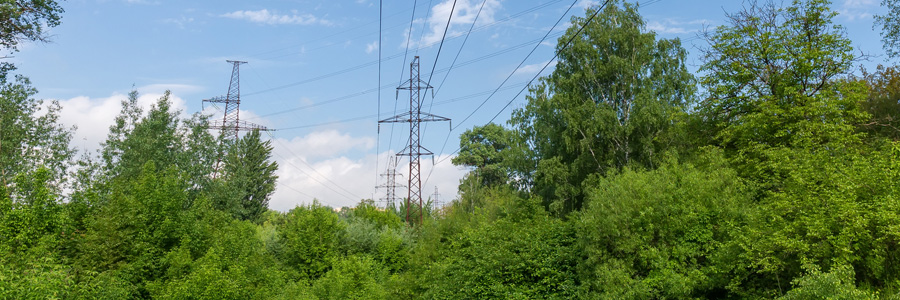
Trees and transmission lines are not compatible. Trees that grow too close to electric transmission lines can conduct electricity and provide a path to ground, potentially causing an interruption and other significant consequences. Trees do not have to physically touch an energized power line to be dangerous. Electricity can arc or jump from a power line to nearby vegetation. In addition to causing an interruption, this can also cause a wildfire and is very dangerous. Electric current flowing through a tree can electrocute anyone in close proximity. Therefore, ensuring trees remain clear of transmission lines is not only vital for service reliability but it is a crucial public and worker safety issue.
We utilize a program called Integrated Vegetation Management (IVM) to establish and foster low-growing vegetative plant communities that, in turn, require minimal maintenance and create numerous benefits for the environment.
We use herbicides to selectively remove tall-growing tree species from the rights-of-way. The remaining low-growing plant communities provide a stable vegetative cover resistant to the re-establishment of tall-growing vegetation. This also provides improved access, erosion control and improved wildlife habitat. The IVM program focuses on complete removal of tall-growing vegetation. Pruning or topping vegetation is a short-term measure that does not provide the same benefits as removal. Topped vegetation poses a higher risk to reliability, safety and does nothing to foster a stable, desirable plant community as the topped trees vigorously sprout back and shade out the desirable plants.
To learn more about ROW biodiversity, please check out National Grid’s ROW Biodiversity Study.
National Grid is a ROW Steward
The Right-of-Way Stewardship Council (ROWSC) Right-of-Way Stewardship Council has accredited National Grid New England (National Grid) as a “Right-of-Way Steward” in recognition of its commitment to sustainable Integrated Vegetation Management (IVM). National Grid is the tenth utility in the United States to receive this distinction.
The ROWSC Accreditation Program was established to evaluate and recognize excellence in environmental stewardship for utility vegetation management along rights-of-way (ROW). Its primary goal is to promote the application of IVM best management practices that enhance power system reliability while supporting ecological benefits on managed ROW corridors.
ROWSC Accreditation Standards are based on the Electric Power Research Institute’s (EPRI) Standards for Assessing Performance of Integrated Vegetation Management on Rights-of-Way and are further refined through additional, well-established forest management frameworks. The program sets rigorous expectations through 10 Principles, 28 Criteria, and 51 Indicators, and requires a comprehensive application process that includes independent third-party audits to verify compliance.
Achieving ROWSC accreditation highlights National Grid’s long-standing commitment to IVM and reinforces its position as an industry leader. The certification process included an extensive review of the company’s Transmission Vegetation Management program documentation, interviews with internal stakeholders across multiple departments, engagement with external contractors performing vegetation work, and field audits conducted at representative sites throughout National Grid’s service territory.
Our goal is to continually improve service reliability. To this end, trees that are growing along the edges of the right-of-way corridors are periodically pruned or removed.
Targeted edge trees are those with hazardous structural defects (e.g., cracks, cavities, decay, poor limb attachments) or those with a history of failure (e.g., poplars, white pine). Research and experience have shown that it is prudent to remove these trees before they cause an interruption.
As the work is carried out, our crews will make every reasonable attempt to protect private property. Disruption to livestock, roadways, soil, fences and gates is avoided as much as possible. Any damages are repaired within a reasonable amount of time after the disturbance.
Cut tree branches are diced close to the ground and left to decompose. Stumps are cut as low to the ground as practicable. Any useable wood, such as larger limbs and/or logs, remains along the right-of-way edge for the landowner.
Due to the potential safety and operational issues mentioned above, it is imperative that we manage our rights-of-way to ensure that only compatible uses are allowed. Existing land uses such as cropland, gardens, lawns, pastureland and planting of low-growing trees and shrubs are compatible with our transmission line rights-of-way. We require the prior written authorization for any new or expanded usage within any right-of-way. Please contact the Transmission Forester in your area to discuss plants that will be suitable for your site. Unauthorized use of our transmission rights-of-way such as planting tall growing trees, cutting or pruning trees, constructing structures, stockpiling materials, excavating or operating heavy equipment all poses a threat to reliability as well as personal and public safety. Unauthorized use could result in the removal of structures or other personal property at the expense of the property owner.
Landowner cooperation is critical to the success of our vegetation management programs. To keep our transmission corridors safe and to prevent injury, property damage, environmental damage and unauthorized use of rights-of-way, we attempt to communicate and cooperate with owners for crew access, maintenance activities, tree removal and security. We also realize the importance of understanding the needs and sensitivities of all property owners.
For information on connecting to the transmission system, please review the Massachusetts Transmission Vegetation Maintenance Documents.
If you have any questions about National Grid’s transmission vegetation maintenance program, please contact us at transmissionforestry@nationalgrid.com