
Bill FAQs
MA Winter Bill Relief
We understand that managing higher gas bills alongside other rising expenses has been challenging. As part of ongoing efforts to reduce energy bills, we are working collaboratively with the Healey-Driscoll Administration, our regulator and other utilities in Massachusetts to adjust rates down in recognition of the sustained cold weather that has caused gas bills to be higher than this time last year, putting strain on household budgets. For your gas use from February 1, 2026 to March 31, 2026, the rate you pay will be reduced by 10%.
All residential gas customers are eligible for MA Winter Bill Relief. If you receive gas and electric service from us, MA Winter Bill Relief will appear on both bills.
Residential gas customers will receive a 10% bill reduction in February and March.
The "MA Winter Bill Relief" credit will be applied to delivery and supply charges and will be prorated based on the number of February and March service days in your billing cycle.
Example:
For February bills, if your billing cycle includes both January and February service days, the MA Winter Bill Relief credit will be prorated to apply only to February service.
For March bills, if your billing cycle includes both March and April service days, the MA Winter Bill Relief credit will be prorated to apply only to March service.
Depending on your gas usage, the credit could reduce February and March gas costs by approximately $26 - $27 each month*.
*Based on average residential natural gas usage of 106 therms per month during the six-month winter heating season - November 1, 2025 to April 30, 2026. Please note: weather and usage patterns can fluctuate during the coldest months, affecting the estimated average cost per month mentioned above.
No. We will not be applying interest charges to the deferred amounts associated with the MA Winter Bill Relief.
We cannot offer the option to opt-out of MA Winter Bill Relief. We appreciate your understanding.
The MA Winter Bill Relief credit will be labeled "MA Winter Bill Relief" within the Delivery Services section of your bill.
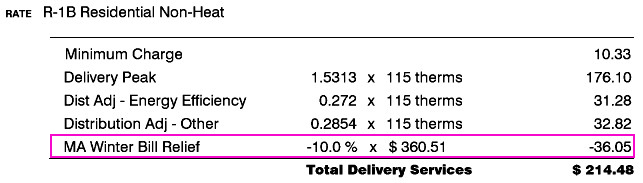
Working collaboratively with our regulator and other utilities in Massachusetts, we have adjusted rates down in recognition of the sustained cold weather that has caused gas bills to be higher than this time last year, putting strain on household budgets.
Because billing cycles often span two months, these credits may appear on bills received in February, March, April, or May, depending on your billing dates.
The MA Winter Bill Relief credit was applied to your total bill charges, not your monthly Budget Plan amount. This means you will not see a difference in your monthly installment amount until the next time your budget plan is reviewed. Your Budget Plan is reviewed every 6 months to account for changes in actual usage and current rates.
If your bill is based on an estimated read, then the entire bill—including the relief discount—is also estimated. The credit is calculated the same way on an estimated bill as it is on an actual read, so there is no difference in how it is applied.
The total deferred amount will be recovered gradually on your bill from May through October, with an estimated monthly amount of approximately $9*.
*Based on average residential natural gas usage of 106 therms per month during the six-month winter heating season - November 1, 2025 to April 30, 2026. Please note: weather and usage patterns can fluctuate during the coldest months, affecting the estimated average cost per month mentioned above.
Yes. If you are on the Discount Rate or any form of financial assistance, you will continue to receive the full discount or benefit in addition to the MA Winter Bill Relief credit.
You can explore our bill help options, which include payment plans, bill assistance programs, and energy saving tips. You can also explore options like our Budget Plan to help offset traditionally high winter heating bills. Doing so makes it easier to anticipate monthly energy costs and plan household budgets.
National Grid and the National Grid Foundation have launched a $5 million statewide initiative supporting seniors and income-eligible households through organizations like United Way, the Good Neighbor Energy Fund, and community foundations.
General Frequently Asked Questions
Our Bill FAQs are a one-stop resource that answers your questions anytime you have them, day or night. We're answering your most common questions about bills, rates, and terms, plus tips on avoiding scams and staying secure.
Your National Grid account number is confidential and should never be shared with strangers—even if they say they’re National Grid employees.
Unethical companies have been known to scam customers into giving up their National Grid account information. Scammers can use your account information to enroll you into services you don’t want—and don't want to pay for. Real National Grid employees will always wear National Grid badges and carry photo IDs when making in-person visits, and National Grid representatives will always know your account number—you never have to provide it.
National Grid does not make promotional calls. For more information, including on how to protect yourself from scams, please visit our Scam Alert information center.
Unfortunately this is a common scam. You should never share your National Grid bill with strangers, and if someone comes to your house claiming to be from National Grid, check for their ID—real National Grid employees will have a National Grid badge.
If this happens to you, please contact us right away.
Spoof calls are a sadly common method of scamming in the utilities world. A spoof call will appear to be coming from a reputable number, like a National Grid’s number, but are really from a third party—typically a scammer or unethical company.
Remember, National Grid representatives who call you will already have your account number.
There are a number of reasons your bill may spike, especially during the holidays.
Environmental factors. When the nights are longer and colder, we tend to spend more time indoors, leading to lights being turned on earlier than usual and for longer periods of time.
Household size. When relatives or friends visit, they often bring an unexpected guest: higher energy usage. An increased household size leads to an increase in lighting and heating up rooms, extra cooking, extra showering, and so on—all things that increase energy usage.
Appliances/Gifts. If you’ve recently bought new appliances or started using new electronics after the holidays, you might be using more energy than normal just by charging up or powering it.
Decorations. We all love holiday lighting, especially around Halloween, Christmas, and the New Year—but it does use energy (sometimes more than we think).
To stay ahead of bill variations and eliminate any surprises in your monthly bill, take a look at our Managing Bill Variations page.
Our Budget Plan program eliminates the highs and lows from your bill and puts control back in your hands.
To calculate your budget bill, we add up your property’s last 12 months of usage. We divide the total by 12 to create one even monthly payment. No fuss involved, no surprises in store—just a steady payment that makes your bill predictable.
If we get to the end of your plan and it turns out our estimates were off, don’t worry—we’ll credit or debit the difference. We try to make sure that doesn’t happen, though, by recalculating your average every few months.
Remember to avoid late or missed payments—these can cause your average to go up when your plan is recalculated.
In May 2024, we updated our billing system for our New York City and Massachusetts gas customers to provide a new, easier-to-read bill experience. This change was part of a consolidation of two existing National Grid billing systems. While this billing system will be “new” for Massachusetts Gas and New York City Gas customers, it is an existing system being used today by millions of other customers. To avoid duplicating accounts after the system conversion, we assigned new National Grid account numbers to our customers being moved to the “new” system. Visit our dedicated billing system upgrade page to learn more about this change.